Why does electric vehicle consumption spike when towing a caravan or trailer?
Thermodynamic and aerodynamic analysis: why a diesel only increases consumption by ~35% while an EV can easily double it (+100%).
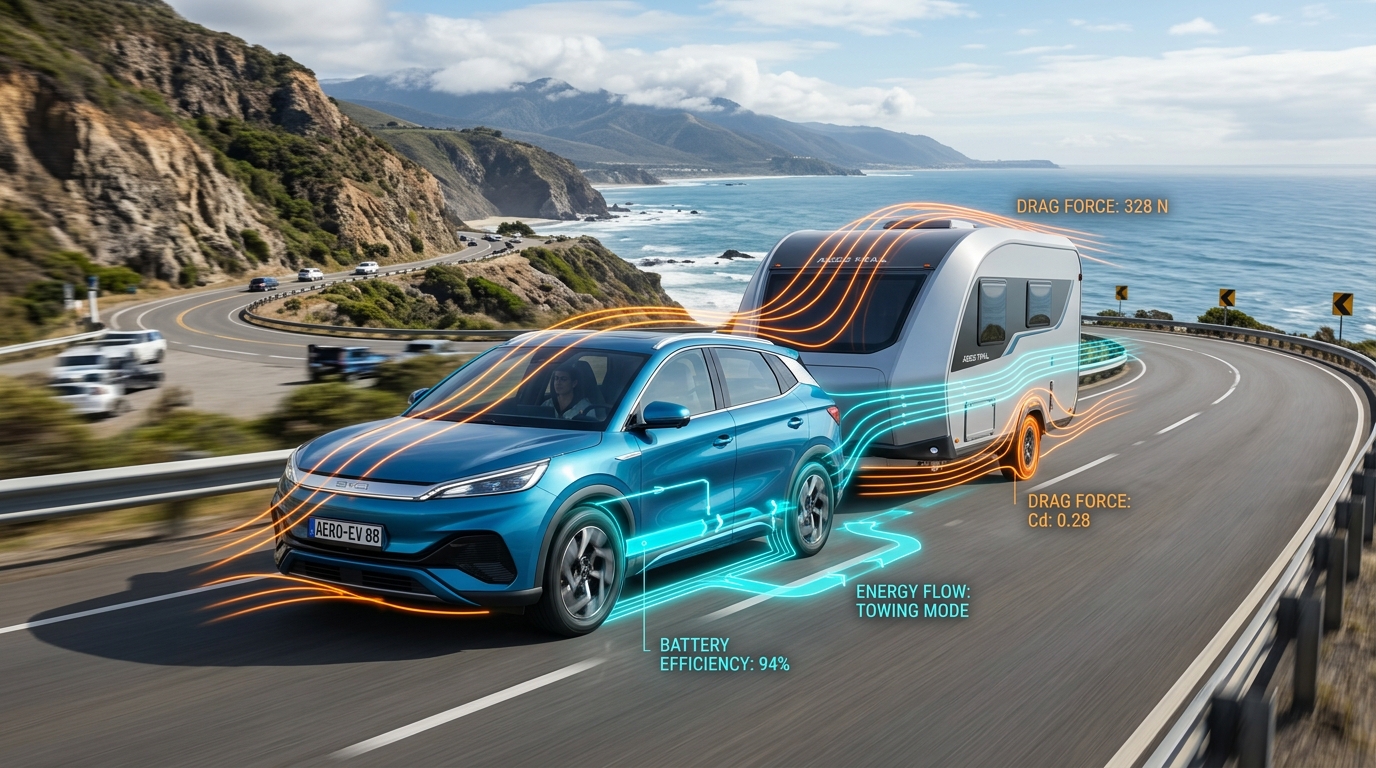
Dynamic towing and consumption simulator
Compare in real time the impact of towing different types of trailers or towball accessories on an EV versus diesel or petrol engines.
Reference energy costs
Where does the demanded energy go?
Vehicle only vs With trailer
Direct comparison: EV vs Diesel vs Petrol at identical speed
| Concept | Electric (Atto 3) | Diesel 2.0 TDI | Petrol 1.5 TSI |
|---|---|---|---|
| Consumption vehicle only | 17.2 kWh/100km | 5.8 L/100km | 6.9 L/100km |
| Consumption with trailer | 33.8 kWh/100km | 9.4 L/100km | 11.8 L/100km |
| Energy penalty (%) | +96.5% | +62.0% | +71.0% |
| Range vehicle only | 351 km | 948 km | 724 km |
| Range with trailer | 179 km | 585 km | 423 km |
| Range loss (%) | -49.0% | -38.2% | -41.5% |
| Cost per 100 km | 8.45 € | 14.10 € | 17.70 € |
| Equivalent useful energy on board | ~54 kWh útiles (60.5 kWh bat) | ~190 kWh útiles (550 kWh brutos) | ~145 kWh útiles (445 kWh brutos) |
The engine efficiency paradox (BSFC map vs 90% EV efficiency)
The electric motor of a BEV has an outstanding baseline efficiency of 88% to 94% under both light and heavy loads. Because it produces almost no residual heat losses, every extra watt of drag is directly drawn from the battery.
In contrast, an internal combustion engine (ICE) is extremely inefficient at light loads (only 20-25% in petrol and 30-35% in diesel), wasting 70-80% of fuel energy as heat. When towing, engine load increases and moves into its optimal BSFC efficiency island, jumping to 35-42%.
Put simply: the combustion engine 'cushions' extra effort by becoming thermodynamically more efficient under heavy load, whereas the electric motor cannot mask the extra work because it was already near-optimal.
Tank capacity: 60 kWh vs 550 chemical kWh
A 55-liter diesel tank holds approximately 550 kWh of gross chemical energy (~190 useful kWh after heat losses). In comparison, an Atto 3 battery stores 60.5 kWh gross (the chemical equivalent of barely 6 liters of fuel).
When towing a full-size caravan and required energy per kilometer doubles (from 18 to 36 kWh/100km in the EV, or 6.0 to 9.5 L/100km in diesel):
In the electric car, depleting 60.5 kWh at 36 kWh/100km cuts range from 340 km down to 165 km (-52%). In diesel, rising from 6.0 to 9.5 L/100km reduces range from 915 km to 575 km, which remains a generous cruising range that also refuels in 3 minutes anywhere.
The aerodynamic wall and cubic power law (P ∝ v³)
Aerodynamic drag force directly depends on vehicle shape and frontal area: Fd = 0.5 · ρ · v² · (Cd · A). Modern EVs are sculpted for extremely low drag (Atto 3 has a Cd of 0.29 with a Cd·A of ~0.75 m²).
A traditional caravan is virtually a vertical wall (Cd of 0.70 to 0.85 and area of 4.8 m²). When attached, laminar airflow collapses at the rear and total Cd·A easily triples.
Since the power required to overcome drag scales with the cube of speed (doubling speed requires 8 times more power), raising cruising speed from 80 km/h to 100 km/h with a caravan adds another ~45% in aerodynamic consumption.
Mechanical overrun brakes and loss of regeneration
During regular EV driving, regenerative braking captures 70% to 85% of kinetic energy during deceleration and downhill slopes.
However, trailers and caravans over 750 kg feature legally required mechanical overrun brakes. When the EV slows down or regenerates, the trailer tongue compresses and triggers mechanical drum brakes on the trailer.
All that kinetic energy and added mass from the caravan is dissipated as heat in its drum brakes, preventing the EV electric motor from recovering it into the battery pack.
Practical guide for towing with an electric vehicle
Driving strategies, en-route charging logistics, and weight regulations.1. The 85-90 km/h golden rule
Towing speed limits across most of Europe are set at 80-90 km/h. Keeping your cruise control at 85-90 km/h rather than pushing to 100 km/h can preserve up to 25% of your battery pack range.
2. Charging logistics: Drive-Through vs standard bays
Most DC fast chargers are standard pull-in or reverse bays. Arriving with a caravan will block lanes or force unhitching. Plan stops at 'Drive-Through' stations (like select Ionity, Zunder or Tesla V4 hubs) or uncouple in an adjacent parking bay before plugging in.
3. Homologation and tow ratings (BYD Atto 3)
Always check your vehicle registration sheet (braked and unbraked tow capacity). The BYD Atto 3 is rated for 750 kg max towing capacity, and a max vertical towball load (S-load) of 50 to 75 kg. Never exceed these ratings to protect suspension and chassis.
4. Tyre pressures and load distribution
An under-inflated trailer tyre can increase rolling resistance by 15%. Check cold tyre pressures before departure. Place heavy loads directly over the trailer axle and ensure a positive tongue weight of 40-60 kg to avoid dangerous trailer sway.